
PRCA, Orchard Hills properties near final city app
Published by Kishan Prajapat, SEO & Content Lead
Drafted with Citeya, an AI writing tool built by KPThink.
TL;DR: PRCA and Orchard Hills properties have reached the final city application stage. If accepted, the project moves from planning into permit approval and early construction. Stakeholders should review the final application, check the city's posted conditions, and prepare for a two- to six-month window of review and possible appeal.
Early context: the headline means PRCA or its client has submitted, or is about to submit, a final application to the city's planning or building department for the Orchard Hills site. The filing typically includes engineering plans, permit requests, and mitigation commitments the city needs to issue final approvals.
What a "final city application" typically means for a development project
A final city application means the developer has finished preliminary approvals and design reviews and is requesting the permits needed to build. The packet tends to include graded site plans, utility designs, stormwater control measures, traffic studies, landscaping plans, and final mitigation language addressing noise, trees, and public access. For planners and permitting staff, this is the time to confirm earlier conditions were met and to set monitoring and bond requirements.
Why PRCA and Orchard Hills reaching this stage matters now
The final application stage changes the project's legal posture. Before this stage, plans are conceptual and conditional. At final application, the municipality evaluates the exact commitments that will be contractually enforceable, such as required road improvements, affordable-housing set-asides, and timelines for public amenities. This matters to nearby residents because the city will post notices and open a short comment period tied to final environmental clearances or code compliance.
How the approval process usually proceeds and the key milestones
After filing, the application enters technical review. That review often runs in cycles. A city reviewer issues comments; the applicant revises and replies; the cycle repeats until technical compliance is reached. If the project triggers environmental review or an environmental impact report, that process has its own public comment deadlines and possible hearings. After technical sign-off, the application moves to final discretionary approval, which could be administrative or require a public hearing before planning commissioners or city council. Once approvals are granted, the city issues building permits after bonds and pre-construction conditions are satisfied.
Expect a timeline measured in weeks to months. Some straightforward projects clear permits in two to three months. More complex sites can take six months or longer, especially if public hearings, additional environmental mitigation, or legal appeals occur.
A concrete example: a hypothetical Orchard Hills parcel through the final-application step
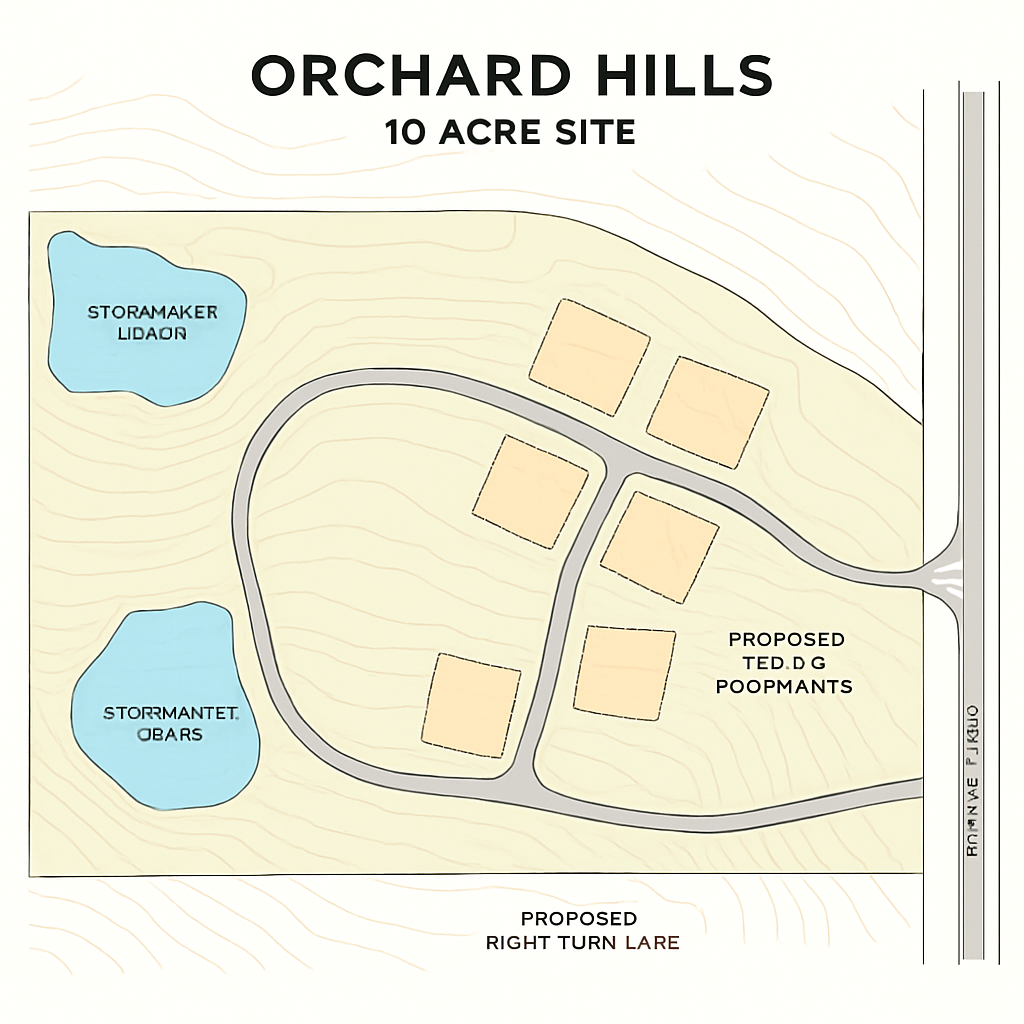
Imagine a 10-acre Orchard Hills parcel zoned for medium-density housing. The developer filed preliminary maps and received conditional approval for 80 homes. For the final city application the packet includes detailed grading plans, a traffic memo that commits to a new right-turn lane on the adjacent arterial, and a stormwater retention design sized to handle a 100-year, 24-hour storm per local code. City reviewers return two comment rounds asking for clarifications on runoff discharge rates and native-tree replacement calculations. The developer revises the designs and posts the performance bond the city requires. Planning staff schedules an administrative permit that includes four enforceable conditions: build the turn lane before issuing occupancy certificates, deliver three units as deed-restricted affordable housing, implement the approved stormwater system, and retain an on-site inspector during earthwork. Once those conditions are satisfied, permits are issued and construction can begin.
The critical change at the final-application stage is the shift from preliminary, conditional approvals to specific, legally binding conditions.
Trade-offs for buyers, residents, and the city
Buyers: final-application approval shortens the time to construction and occupancy, reducing market risk for those who want to know when homes will be available. But buyers also accept that the developer is making final design choices; buyers should insist on clear build windows and warranty timelines before signing.
Residents: final plans give neighbors precise details on traffic mitigations, grading, and tree protections, but they also reduce the room for negotiation. Conditional approvals from preliminary stages often left space for changes; final applications convert promises into enforceable conditions.
City: the municipality gains enforceable commitments and technical designs to inspect, but it also assumes inspection and enforcement costs. Cities manage that expense through bonds and permit fees. If a city accepts inadequate mitigation in haste, the long-term costs can be fiscal and environmental.
Three immediate steps stakeholders should take
1) Review the public filing. The final application packet contains the exact engineering drawings and mitigation language that will govern construction and long-term maintenance. For neighbors, the key pages are grading limits, tree-protection plans, and any traffic-solution schematics. For buyers, focus on construction schedule and any deed restrictions.
2) Note the city's comment and appeal deadlines. Municipal comment periods are short. If a condition is missing or unclear, file a comment or ask for a clarifying amendment while the comment period is open.
3) Check bonds and enforcement language. Confirm the city is requiring performance bonds or escrow amounts that cover likely remediation costs if the developer fails to meet conditions. Also check who inspects erosion controls during rainy months, and how long the warranty on infrastructure runs.
A caveat: common risks and how to spot them early
One common risk is scope creep during construction. Even after final approval, developers sometimes seek minor field adjustments. Many codes allow administrative deviations for site constraints, and those can add imperceptible changes that cumulatively matter, such as smaller setbacks, shifted drainage grades, or tree removals. Watch for "minor modification" filings and request that any change with community impact be treated as a public amendment rather than an administrative edit.
Another frequent problem is weak enforcement language. A city might accept a developer's plan for affordable units but not define inspection or default remedies. If the final application lacks a clear remediation path, community groups and buyers should press the city to add specific cure deadlines and liquidated-damage provisions.
Practical takeaway you can act on today
If you live near Orchard Hills or plan to buy there, go to the city’s planning portal, download the final application packet, and set calendar reminders for the comment and appeal deadlines. If you represent a neighborhood group, compile specific, technical questions about grading, runoff, and traffic before the comment period closes. Buyers should ask for a construction timetable written into purchase agreements and verify that the city has adequate performance bonds in place.
Warning: do not wait until construction starts to raise technical objections. Once buildings go up, remedies are far more costly and slow. Acting now keeps your options real.
Image prompts
1) A high-resolution site-plan sheet showing a hypothetical Orchard Hills 10-acre parcel with labeled grading contours, proposed housing footprints, stormwater basins, and a proposed right-turn lane on an adjacent arterial road, daytime, crisp vector-map style.
2) A realistic streetscape rendering of Orchard Hills during early construction, showing silt fences, erosion-control measures, a flagged native-tree protection area, construction signage with city permit numbers, and nearby single-family homes watching from the sidewalk; mid-afternoon light, photorealistic.
seo.meta_description: "PRCA and Orchard Hills properties have reached the final city application stage; learn what that means, the timeline, trade-offs for neighbors and buyers, and three immediate actions to take."
Spotted a mistake? Tell usand we'll correct it.
Related Articles

Hammond Power Solutions Inc. (HPS-A.TO) Stock Pric: What Investors Should Know Now
Clear, source-backed analysis of Hammond Power Solutions Inc. (HPS-A.TO) stock price drivers, recent results, valuation trade-offs, and a practical next step for investors.

Services PMI® at 54.9%; September 2026 ISM® Servic
The ISM Services PMI fell to 54.9 in September 2026; this article explains what that means for technology and IT services firms, why price pressures matter, and three steps leaders should take now.

Meta’s Muse AI collects private user data — what that means for your photos and privacy
Meta’s Muse AI uses public Instagram photos and other user data despite privacy claims; learn what it collects, why it matters, and steps to reduce exposure.

Could AI predict migraine before it strikes? Study
A clear look at whether artificial intelligence can forecast migraine attacks before symptoms begin, what data and models matter, real-world trade-offs, and one practical step you can take today.